


Can I Use Competitor Brand Keywords in Google Ads?
Can I Use Competitor Brand Keywords in Google Ads?
This article explains Google Ads policies and general PPC strategy. It is not legal advice. Trademark rights and advertising laws vary by jurisdiction; consult qualified legal counsel before launching a campaign that targets a competitor’s brand name.
Short answer: Google Ads generally does not restrict the use of another company’s trademark as a keyword alone, but that does not mean every competitor campaign is legally risk-free. Google may restrict a trademark’s use in ad copy, particularly when the advertiser is a direct competitor or the ad is confusing, deceptive, or misleading. Advertisers are still responsible for complying with applicable trademark and advertising laws in the markets where their ads run.
If you’ve ever searched your own brand name and seen a competitor’s ad show up above yours, you already know how common this practice is. Bidding on competitor brand names is one of the most debated topics in the Google Ads community, and for good reason: what Google allows and what trademark law protects are two different questions.
What Does “Bidding on a Competitor’s Brand” Actually Mean?
There are two very different things people mean when they talk about using competitor brands in Google Ads, and confusing them is where most of the risk comes from.
- Adding the competitor’s brand name as a keyword. This is a targeting decision. You tell Google Ads to show your ad when someone searches for a competitor’s brand name. The competitor’s name doesn’t necessarily appear anywhere in your ad copy or landing page.
- Using the competitor’s trademark in your ad copy. This is a different action entirely, something like “Switch from [Competitor] to Blue Monkfish” in your headline. Putting a competitor’s name directly in your ad copy is materially different from simply bidding on the term as a keyword, and it’s the part of this strategy that carries the most risk.
Google’s own trademark policy draws this exact distinction: it generally does not restrict trademarks used only as keywords, but it can restrict trademark use inside the ad itself, especially when a direct competitor is using another company’s brand name to trigger their ad. This is the single most important thing to understand before running any campaign targeting competitor terms.
Is It Legal to Bid on Competitor Keywords?
Here’s where things get more complicated than most quick answers online suggest. Being allowed by Google Ads policy and being legally safe under trademark law are not the same thing, and it’s worth being precise about what the courts have actually said rather than making a blanket claim either way.
Network Automation v. Advanced Systems Concepts (9th Circuit, 2011) is probably the most directly relevant case here. Network Automation purchased its direct competitor’s trademarked term “ActiveBatch” as a search keyword to advertise its own competing software. Advanced Systems Concepts sued for trademark infringement and won a preliminary injunction at the district court level. But the Ninth Circuit vacated that injunction, finding the lower court had relied too heavily on outdated factors and hadn’t adequately shown a real likelihood of consumer confusion. The case didn’t establish that competitor keyword bidding is always fine, it depended on the specific facts of consumer confusion.
Rosetta Stone v. Google (4th Circuit, 2012) involved similar questions about trademark use inside Google’s advertising program. The Fourth Circuit reversed summary judgment that had favored Google on several trademark claims, and the case was later settled confidentially between the two companies.
FTC v. 1-800 Contacts (2018) is worth including because it ran in the opposite direction. Here, the FTC challenged agreements where 1-800 Contacts had gotten competitors to agree not to bid on its brand name at all. The FTC argued these agreements restrained competition and reduced the number of relevant ads available to consumers searching that term. This case is a useful reminder that regulators have scrutinized both overly aggressive and overly restrictive brand-bidding practices.
1-800 Contacts v. Warby Parker (2nd Circuit, 2024) is the most recent and arguably most telling case. The Second Circuit pushed back on trademark owners suing over competitive keyword advertising itself, reflecting a broader judicial trend toward treating keyword bidding, when it isn’t paired with confusing ad copy, as generally acceptable.
Taken together, these four cases don’t support the claim that competitor keyword bidding is universally legal or universally risky. What they consistently show is that outcomes depend on the specific facts: the actual ad copy shown to searchers, evidence of real consumer confusion, and the relationship between the two companies involved.
Can You Use a Competitor’s Brand Name in the Ad Itself?
This is where the real risk concentrated. Here’s a practical breakdown of what tends to be treated differently:
| Scenario | Recommended Treatment |
| Competitor brand used only as a keyword | Different from using it in ad copy |
| Competitor’s name appears in your headline | Higher trademark and policy risk |
| Competitor’s name appears in your description | Review carefully before running |
| Claiming you are the competitor | Avoid entirely |
| Implying affiliation or endorsement | Avoid entirely |
| Comparing genuinely different products or services | Requires careful, honest framing |
| Making a misleading competitor claim | Avoid entirely |
Google’s trademark complaint process specifically looks at whether a trademark is used by a direct competitor in a way that’s confusing, deceptive, or misleading, not simply whether the term was used as a targeting keyword. If you’re eligible to use a trademarked name in your ad copy at all (say, as an authorized reseller or a compatible-product provider), that’s a narrow exception, not the default rule for competitors.
Competitor Brand Bidding vs. Competitor Conquesting
In PPC strategy circles, deliberately targeting searches associated with another company’s brand name is often called competitor conquesting. The real question with any competitor campaign isn’t just “can we bid on it?” It’s “should we?”
There are legitimate reasons to test it: real category demand, users who are actively comparing alternatives before they decide, a genuinely strong differentiator worth surfacing, and high commercial intent behind the search itself.
There are also real reasons it can backfire: lower conversion quality since the searcher may simply want the competitor and nothing else, a higher cost per click than your own brand terms typically carry, weaker landing-page relevance if the page doesn’t actually address why someone searching a competitor’s name should consider you instead, and genuine trademark exposure if the ad copy isn’t handled carefully.
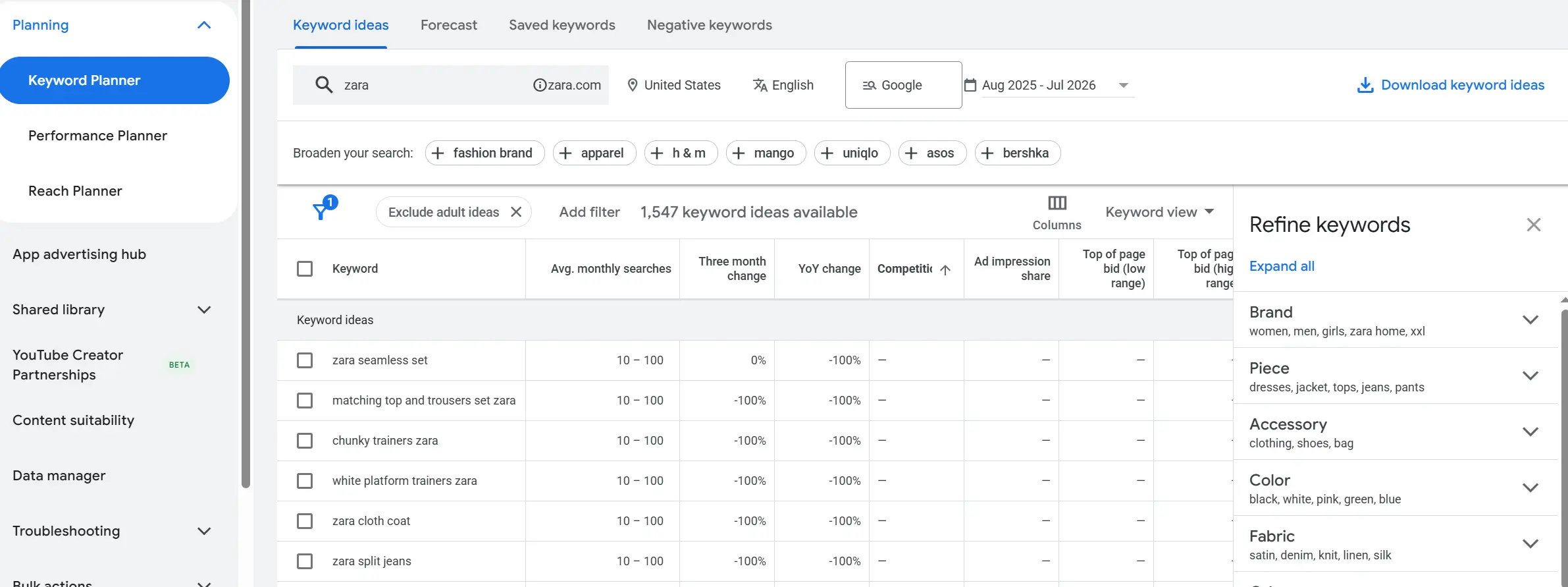
Don’t assume a competitor campaign will automatically produce cheaper clicks or better conversions than other strategies. Tools like Google’s Keyword Planner and Auction Insights exist specifically so you can look at real data, search volume, cost estimates, and which advertisers are already showing up in the same auctions, rather than guessing.
How to Find Competitor Keywords in Google Ads
If you’re considering this strategy, a structured approach works better than picking competitor names at random.
Start by identifying competitors that genuinely overlap with what you’re advertising, not every company in your broader industry.
Use Google Keyword Planner to pull keyword ideas along with volume and cost estimates for the terms you’re considering.
Review your Search Terms report regularly once campaigns are live, to see the actual queries triggering your ads and catch anything irrelevant early.
Use Auction Insights to see which other advertisers are showing up in the same auctions as your existing ads, this is one of the clearest ways to understand your actual competitive landscape in Google search results.
Keep competitor research separate from competitor bidding. Researching what a competitor’s audience is searching for doesn’t mean every one of those terms belongs in a live campaign.
How to Build a Competitor Keyword Campaign
If you decide to move forward, structure matters. Rather than dumping every competitor name into one giant ad group, separate campaigns by competitor, or at minimum by ad group, so your messaging and landing pages can stay relevant to each one.
Your landing page needs to do real work here. It should clearly explain who you are, what you’re offering, and why someone who searched for a competitor might want to consider you instead, with a clear next step. A landing page that does nothing but repeat competitor names to capture search traffic isn’t just a weak strategy, it also increases the risk that the whole campaign gets read as an attempt to mislead rather than genuinely compete.
What Should Your Ad Actually Say?
The safest and often most effective direction is to keep your ad copy focused on your own offering rather than name-dropping the competitor. Something like “Digital Marketing Strategy Built Around Your Goals, SEO, PPC, Web Design & Branding” tells the searcher clearly what you do, without needing to reference anyone else by name.
Direct comparative claims like “Better Than [Competitor]” carry more risk and generally require substantiated evidence to back up the claim, along with confirming the comparison itself complies with Google’s advertising policies around truthful, relevant advertising.
What If a Competitor Is Bidding on Your Brand Name?
If you notice a competitor’s ad showing up when someone searches your brand, it’s worth working through this methodically rather than reacting immediately.
First, confirm the competitor is actually appearing consistently, not just once. Check Auction Insights within your own account to see real overlap data on your branded campaigns. Then look specifically at their ad copy, not just the fact that they’re triggering on your brand term, since the copy is what actually determines whether there’s a real trademark issue. Document what you find with screenshots, dates, and search queries. If the ad copy itself is using your trademark in a way that seems confusing or misleading, Google does provide a trademark complaint process for reviewing that specific concern. And if there’s a real question of consumer confusion or misleading claims, that’s the point to involve legal counsel rather than assuming any single action will resolve it.
One important thing not to promise yourself or a client: submitting a complaint doesn’t guarantee Google will remove a competitor’s ad. Google’s review process looks at the specific facts of each case.
What About a Cease-and-Desist for Brand Bidding?
A cease-and-desist letter is a legal and business action, not a setting inside your Google Ads campaign. Whether a particular use of your name actually violates trademark law depends on the jurisdiction and the specific facts involved, which is exactly why this is a conversation for legal counsel rather than something to resolve inside the ads platform alone. Interestingly, the Network Automation case referenced earlier actually began with a cease-and-desist letter that escalated into full litigation, a real example of how this path can play out.
Can Competitor Keyword Bidding Hurt Your PPC Performance?
Beyond the trademark question, there’s a straightforward performance question worth answering with data rather than assumptions. Track cost per click, click-through rate, conversion rate, cost per qualified lead, and impression share on any competitor campaign the same way you would any other part of your Google Ads strategy. Treat it as a testable acquisition tactic and judge it against the same business outcomes you’d expect from any other campaign, not as something universally good or universally bad.
Competitor Keyword Bidding: Pros and Cons
| Potential Advantage | Potential Drawback |
| Captures competitor-related searches | Searcher may only want the competitor |
| Can expose your brand as an alternative | Can create weaker overall ad relevance |
| Useful for controlled, measurable testing | May increase acquisition costs |
| Reveals genuine commercial search intent | Comes with real trademark considerations |
Competitor Keyword Bidding Checklist
Before launching any campaign targeting competitor terms, it’s worth running through a short list:
- Is the competitor genuinely relevant to what you offer?
- Is the keyword itself commercially relevant, not just a name match?
- Is the trademark being used only as a keyword, or does it also appear in your ad copy?
- Does your landing page actually match what someone searching that term is looking for?
- Are any comparative claims in your ad substantiated?
- Have trademark considerations been reviewed?
- Are negative keywords configured to filter out irrelevant searches?
- Is conversion tracking actually working before you scale spend?
- Do you have a defined cost-per-acquisition target to judge the test against?
Should You Consider Competitor Brand Keywords for Your Own Google Ads Strategy?
Competitor-brand campaigns work best as a controlled, measurable experiment, not as a replacement for building visibility around your own brand and services. Before running ads targeting competitor brand names, it’s worth working through both the strategic question (does this genuinely fit your goals) and the policy question (is your ad copy and landing page set up the right way) together.
Not Sure If Competitor Bidding Fits Your PPC Strategy?
Blue Monkfish can help evaluate whether competitor conquesting makes sense for your specific goals, budget, and market, as part of a broader Google Ads strategy built around real data, not assumptions.
Book a PPC Strategy Consultation
Frequently Asked Questions
Can I use competitor brand keywords in Google Ads?
Generally yes, Google Ads does not restrict trademarks used solely as targeting keywords. Using the trademark in your actual ad copy is a separate matter with real restrictions, especially for direct competitors.
Is it legal to bid on competitor keywords?
It depends on the specific facts. U.S. courts have looked at likelihood of consumer confusion case by case rather than issuing a blanket rule, so legality isn’t guaranteed just because Google’s platform allows the keyword targeting.
Can a competitor use my company name as a keyword?
Yes, this alone isn’t something Google will typically restrict. What matters more is whether their ad copy or landing page uses your name in a way that’s confusing or misleading.
How can I prevent competitor brand bidding?
You can’t fully prevent competitors from bidding on your brand name as a keyword. Running your own consistent brand campaign, monitoring Auction Insights, and addressing misleading ad copy through Google’s trademark complaint process are the practical options available.
What should I do if a competitor is bidding on my brand name?
Confirm the pattern is real using Auction Insights, review their actual ad copy carefully, document what you find, and pursue Google’s trademark complaint process or legal counsel if the ad copy itself raises genuine confusion concerns.
What is competitor brand bidding or PPC conquesting?
It’s the practice of deliberately targeting searches associated with a competitor’s brand name in Google Ads, aiming to win some of that searcher’s consideration for your own business.
A reminder: this article covers general Google Ads policy and PPC strategy, not legal advice. Trademark outcomes depend on jurisdiction and specific facts, consult a licensed attorney for guidance on any specific campaign.
Sources
- Google Ads Trademarks Policy
- Google Ads Help — Keyword Planner
- Google Ads Help — Auction Insights
- Network Automation, Inc. v. Advanced Systems Concepts, Inc., 638 F.3d 1137 (9th Cir. 2011)
- Rosetta Stone Ltd. v. Google, Inc., 676 F.3d 144 (4th Cir. 2012)
- In the Matter of 1-800 Contacts, Inc., FTC Docket No. 9372
- 1-800 Contacts v. Warby Parker, 2nd Cir. 2024

