

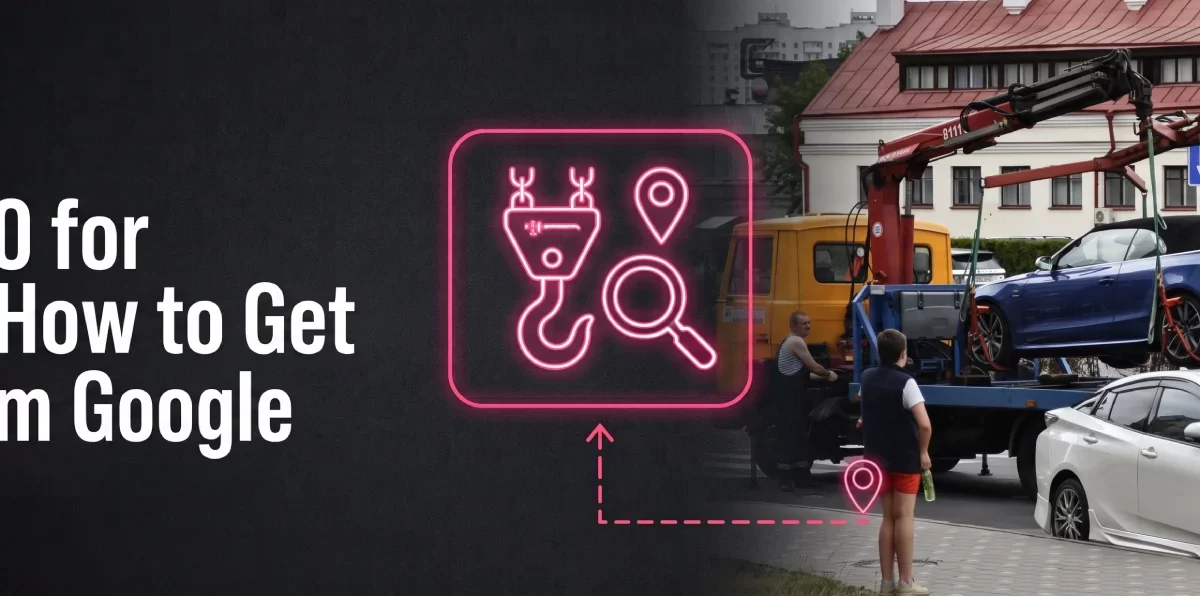
Local SEO for Towing: How to Get More Calls From Google
Local SEO for Towing: How to Get More Calls From Google
A driver’s car stalls on the shoulder of a busy road. Their tire blows out in a parking lot at midnight. They lock their keys inside and have somewhere to be in twenty minutes. In every one of these moments, the first thing they do is pull out their phone and search for a tow truck near them.
That search is the entire opportunity. The towing company that shows up in that moment, looks trustworthy, and makes it easy to call wins the job. Local SEO for towing is the process of improving a towing business’s visibility in Google Search and Google Maps for the searches that matter most: location based, service specific, and urgent. Done well, it turns local search results into a steady stream of calls instead of a guessing game.
This guide walks through how local search actually works for towing companies, what to prioritize, and how to build a towing SEO strategy that holds up over time.
How Google Local Rankings Work for Towing Companies
Before optimizing anything, it helps to understand what Google is actually measuring. Google has said publicly that local rankings come down to three factors: relevance, distance, and prominence.
Relevance is how well a business matches what someone searched for. A towing company that clearly lists emergency towing, flatbed towing, and roadside assistance is more relevant to those specific searches than one that only says “towing services.”
Distance is how close a business is to the person searching or to the location included in their search. This is mostly outside a business owner’s control, but listing an honest, realistic service area keeps a Google Business Profile aligned with the areas a company can actually reach.
Prominence is how well known and well regarded a business appears online. Reviews, mentions, backlinks, and a consistent digital presence all feed into this. A towing company with strong prominence tends to outrank one with a similar service area and nearly identical listing information.
Every part of a local SEO strategy for towing ties back to one of these three factors.
Optimize Your Google Business Profile
For a towing company, the Google Business Profile is often the single biggest factor in local search visibility. It is what shows up in the map pack, and for many searchers, it is the first and only thing they see before calling.
Start with the primary category. “Towing Service” should almost always be the primary category, with relevant secondary categories added where they genuinely apply. The business name, address, and phone number need to match exactly across the profile and the rest of the web. Small inconsistencies, like a suite number appearing on one directory and not another, can quietly work against a listing’s trustworthiness.
The service area should reflect where the business can realistically respond, not the largest radius that seems appealing. Listing a service area a truck cannot reach in a reasonable time creates a mismatch between what Google shows and what a driver actually experiences, which tends to show up in reviews.
List only the services actually provided. If a company handles motorcycle towing, heavy duty towing, or lockouts, those should be reflected as individual services rather than folded into a single generic listing. Add real photos of the trucks, the yard, and the team. A profile with genuine, current photos reads as more active and trustworthy than one with a stock image or nothing at all.
Behind the scenes, adding LocalBusiness and Service schema markup to the website reinforces the same information Google already sees in the Business Profile, giving search engines a clearer, more structured picture of what the company offers and where.
Build a Keyword Strategy Around Search Intent
Most towing keyword lists are just a pile of terms. A stronger approach groups keywords by what the searcher actually needs at that moment.
Emergency keywords cover situations where someone needs help right now: “emergency towing,” “tow truck near me,” “need a tow truck.” These searches convert fastest and deserve the clearest, most direct calls to action.
Service specific keywords describe a particular type of job: “flatbed towing,” “motorcycle towing,” “heavy duty towing,” “accident recovery.” Someone searching these terms already knows what they need; the content just has to confirm the business provides it.
Location based keywords combine towing with a place: “towing company in [city],” “tow truck [city].” These searches are about finding a local provider, which is exactly what a well built Google Business Profile and location page are meant to capture.
Informational keywords are earlier in the decision process: “how much does towing cost,” “what to do if your car breaks down.” These searches rarely convert immediately, but content built around them builds topical authority and can bring in visitors who remember the business later, when they actually need a tow.
Matching content to the right bucket, rather than repeating the same broad term everywhere, is what separates a real keyword strategy from keyword stuffing.
Create Real Service and Location Pages, Not Thin Duplicates
A single “Our Services” page rarely does justice to everything a towing company offers. Dedicated pages for emergency towing, flatbed towing, roadside assistance, and any other core service give Google, and potential customers, a clearer answer to a specific question. Each page should explain what the service involves, who typically needs it, the areas it covers, and end with a strong, visible way to call.
Location pages work the same way, but they come with a warning. If a company serves several cities, a page for each one can genuinely help demonstrate local relevance. The mistake is creating pages that are identical except for a swapped city name. Google’s guidance on helpful content is direct about this: pages built primarily to capture search traffic, without real, useful information behind them, tend to underperform and can drag down a site’s broader search engine rankings.
A location page worth building includes real detail. What roads or areas does the crew actually cover from that location. Are there specific questions customers in that area tend to ask. Is there any local detail, like proximity to a major highway, that is genuinely useful context. That is the difference between a page that helps rank higher on Google and one that just adds bulk to a website.
Reviews, Citations, and Local Authority
Reviews do double duty. They feed directly into the prominence factor Google uses for local rankings, and they are often the deciding factor for a customer choosing between two nearby towing companies. Asking for a review right after a completed job, when the experience is still fresh, tends to work better than a delayed request. Responding to reviews, including critical ones, shows an active, accountable business. What should never happen is manufacturing reviews or offering incentives for them, which risks both trust and the listing itself.
Citations, meaning consistent business listings across directories like Yelp, the Better Business Bureau, and towing specific directories, reinforce the same NAP information Google already relies on. The goal is not to be listed everywhere possible, but to be listed accurately on the directories that matter.
Backlinks from genuinely relevant local sources, such as auto repair shops, dealerships, or insurance agents a towing company actually works with, build real world authority. These relationships work best when they reflect an actual business connection rather than a link built purely for search engine optimization purposes.
Build a Website That Converts Visibility Into Calls
Ranking well only matters if it leads to a call. A towing website needs to load quickly on a phone, since most searches in this category happen on mobile devices from people who are not in a position to wait. A click to call button should be visible without scrolling, on every page, not buried in a footer.
Trust signals matter here too. Reviews, real photos, and clear information about the service area all reassure a visitor who has never used the company before. The goal on every page is the same: make it obvious what the business offers and make calling the easiest possible next step. A visitor who has to search for a phone number is a visitor who may just call the next result instead.
The path from a search to a customer generally looks like this: search, map pack or organic result, service page, trust signals, phone call, dispatch. Every piece of a local SEO strategy exists to support that path, not just to improve a ranking number in isolation.
SEO Versus Google Ads for Towing Companies
SEO and Google Ads are not competing strategies; they serve different roles. Local SEO builds visibility that compounds over time and keeps generating calls without an ongoing cost per click. Google Ads, including Local Services Ads built specifically for service businesses, can generate calls quickly for a targeted search, which is useful during a slow season or in a highly competitive market.
A reasonable approach uses both: SEO as the long term foundation, and paid search as a lever to pull when extra visibility is needed for a specific area, service, or time period. Framing this as one being simply better than the other misses how most towing companies actually use their marketing budget in practice.
Choosing a Towing SEO Agency
Not every marketing agency understands what makes towing searches different from other local businesses. A towing SEO agency worth hiring should be able to explain how it will audit the current Google Business Profile and website, build out a keyword and service page strategy based on real search intent, and track results by calls and leads, not just keyword rankings.
Be cautious of any towing digital marketing agency promising a guaranteed ranking or a fixed timeline to reach page one of Google. Search engine rankings depend on too many variables, including competition and existing site history, for that kind of promise to be reliable. A trustworthy agency will set realistic expectations and show its work through actual visibility and call data over time.
Bringing It Together
Local SEO for towing is not a single tactic or a box to check once. It is a system: an accurate Google Business Profile, service and location pages built around real search intent, genuine reviews, a website designed to convert a visit into a call, and a clear sense of where paid search fits in alongside it. Towing companies that treat these pieces as connected, rather than isolated tasks, tend to see steadier results in local search results over time.
If building or refining that system feels like more than an in house team has time for, Blue Monkfish works with local service businesses on exactly this kind of local SEO strategy, from Google Business Profile management through website and content work.
Frequently Asked Questions
What is local SEO for towing companies?
Local SEO for towing companies is the practice of improving visibility in Google Search and Google Maps for searches tied to a location and a specific towing need, such as emergency towing or roadside assistance, so that nearby customers can find and call the business.
How do I get my towing company to show up on Google Maps?
Start with a complete, accurate Google Business Profile: the correct category, consistent business name and contact details, an honest service area, and real photos. Combine that with genuine customer reviews and a website that reflects the same information consistently.
Is SEO or Google Ads better for towing companies?
Neither replaces the other. SEO builds lasting organic visibility, while Google Ads and Local Services Ads can generate calls quickly for specific searches. Many towing companies use both together, depending on budget and competition.
How long does local SEO for towing take?
Timelines vary based on the local market, existing website authority, and how complete the Google Business Profile already is. Rather than expecting a fixed number of days, it helps to track progress through growing visibility, website traffic, and calls over several months.
How much does towing SEO cost?
It depends on market competition, number of service areas, website condition, and how much content and technical work is needed. There is no fixed industry rate.
Do location pages help towing companies rank?
Yes, when they contain genuine local detail. Duplicate pages that only swap the city name can hurt rankings rather than help them.
How important are Google reviews for towing companies?
Very. Reviews directly influence local ranking prominence and are often the deciding factor for customers comparing nearby towing companies.

