

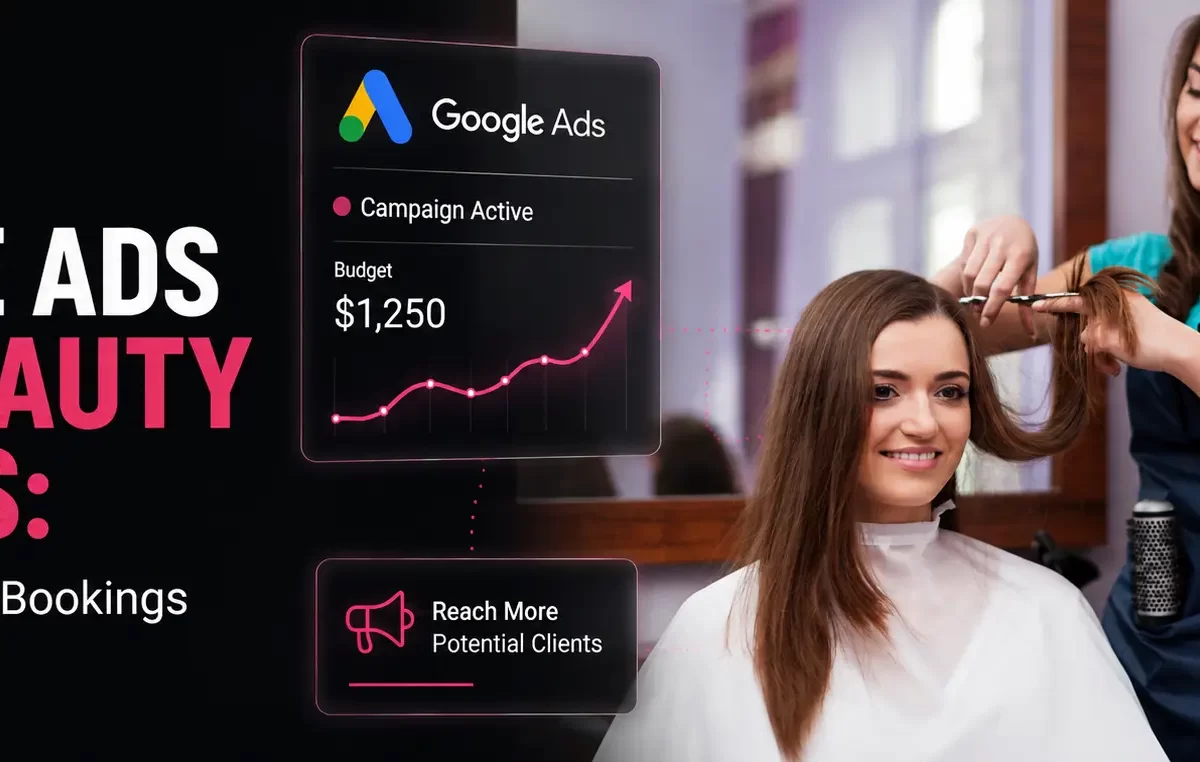
Google Ads for Beauty Salons: Get More Bookings | Blue Monkfish
Google Ads for Beauty Salons: How to Get More Bookings
A salon can have talented stylists, glowing reviews, and a beautiful website and still struggle to bring in new clients if people can’t find it at the exact moment they’re ready to book. That’s the gap Google Ads is built to close. Unlike organic search, which takes months to build momentum, Google Ads captures people who are actively searching right now, someone typing “balayage near me” while sitting in a waiting room, or “hair salon near me” between meetings.
Running Google Ads for a salon isn’t complicated, but it is easy to get wrong. This guide walks through how Google Ads actually works for beauty salons, what keywords and campaign types perform best, and how to measure success by bookings, not just clicks.
Quick answer: Yes, Google Ads works well for beauty salons because salon searches carry high, specific intent, people searching are usually ready to book, not just browsing. Success depends less on ad spend and more on campaign structure, keyword targeting, and whether the landing page actually converts that click into an appointment.
How Do Google Ads Work for Beauty Salons?
Google Ads works differently than most people expect. It’s not about buying visibility, it’s about bidding to show up when someone searches a specific term. For a salon, that usually means a Search campaign built around keywords, ad groups organized by service, and a landing page to which each ad points. Google Business Profile also plays a role here, since a well-optimized business profile supports the local visibility that pairs with paid search.
The core pieces are: keyword research, ad groups, the ad copy, conversion tracking, and a bidding strategy that tells Google what result you’re optimizing for, clicks, calls, or form submissions.
Why Google Ads Can Work So Well for Salons
Google Ads Captures People Already Searching for a Service
This is the core advantage over almost every other marketing channel. Someone searching “hair salon near me” or “balayage near me” has already decided they want a service, they just haven’t decided where yet. Google Ads puts your salon in front of that person at the exact right moment, rather than hoping they stumble across a Facebook ad while scrolling for something unrelated.
Google Ads Reaches Customers at the Booking Stage
Not all searches carry the same intent. “Best hairstyles for summer” is awareness-stage browsing. “Balayage salon near me” is commercial intent, they’re comparing options. “Book balayage appointment [city]” is transactional, they’re ready to act. The strongest salon campaigns are built around that second and third category, since that’s where ad spend converts into actual booked appointments.
Google Ads Provides Visibility While SEO Is Still Growing
SEO is a long-term asset, but it takes time. Google Ads fills that gap immediately. The two aren’t competitors, they work best together: paid search brings in bookings now, while organic content and a strong salon website build compounding visibility over time.

What Types of Beauty Businesses Can Use Google Ads?
Google Ads for Beauty Salons
A full-service beauty salon benefits from campaigns organized around its actual service menu, hair, nails, skin, rather than one generic “beauty salon” campaign trying to cover everything at once.
Google Ads for Hair Salons
Hair salons should build ad groups around specific, high-intent services, haircuts, color, balayage, highlights, extensions, keratin treatments, rather than bidding broadly on “hair salon” alone.
Google Ads for Nail Salons
Nail salons see strong results from service-specific keywords: manicure, pedicure, gel nails, acrylic nails, nail art. These terms tend to have clearer intent and less competition than broad “nail salon” bids.
Google Ads for Salons and Spas
Spas and combined salon-spa businesses should build separate campaigns for facials, massages, skincare, and wellness treatments, since these attract a different searcher than someone looking for a haircut.
Google Ads for Beauty Schools
This is a meaningfully different use case. A beauty school isn’t targeting walk-in clients, it’s targeting prospective students searching for cosmetology or esthetician programs, course details, and tuition information. The keyword strategy, ad copy, and landing pages all need to reflect enrollment intent, not appointment intent. Treating a beauty school campaign like a salon campaign is one of the more common mismatches in this space.
What Keywords Should Beauty Salons Target in Google Ads?
Keyword research is where most salon campaigns succeed or fail. Google’s Keyword Planner is the standard starting point for finding related keywords, checking search volume, and gauging competition before you commit budget.
| Search Intent | Example |
| Service | balayage salon |
| Location | hair salon [city] |
| Near me | nail salon near me |
| Appointment | book hair appointment |
| High value | hair extensions salon |
Service + location keywords (“hair salon Hoboken,” “balayage Hoboken”) combine what someone wants with where they want it, these tend to convert well because they’re specific.
“Near me” keywords capture people searching with immediate local intent, often on mobile, often ready to book same-day.
Appointment-intent keywords (“book hair appointment,” “same day salon appointment”) are some of the highest-converting terms available, since the searcher has already decided to take action.
High-value service keywords (hair extensions, bridal hair, luxury facial) often justify a higher cost per click because the resulting booking is worth more.
Brand keywords matter if people already know your salon by name but haven’t booked yet. Competitor keywords can work but carry risk, low relevance scores and higher costs are common, so this needs a deliberate strategy rather than a blind bid.
Negative keywords deserve equal attention. Without them, a salon campaign can burn budget on searches like “hair salon jobs,” “cosmetology courses,” or “free haircut tutorial,” clicks that will never turn into bookings.
Which Google Ads Campaign Structure Works Best for Salons?
Structure matters as much as the keywords themselves. Separating services into distinct campaigns and ad groups improves ad relevance, keeps each landing page focused, and makes it far easier to see which specific service is actually driving revenue.
| Campaign | Ad Groups |
| Hair Services | Haircut, Color, Balayage, Extensions |
| Nail Services | Manicure, Pedicure, Gel, Acrylic |
| Beauty Services | Facial, Waxing, Lash |
An ad group for balayage, for example, should have its own tightly matched keywords, its own ad copy mentioning balayage specifically, and its own landing page, not a generic homepage that makes the searcher hunt for the service they clicked on.
How to Write Effective Google Ads for Beauty Salons
Strong ad copy follows a few consistent patterns:
Put the service in the headline. A search for “balayage near me” should be met with an ad that says balayage, not a generic “book your appointment today.”
Use location naturally. Mentioning the neighborhood or city builds immediate relevance without feeling forced.
Highlight a real differentiator, experienced stylists, same-day availability, online booking, only if it’s actually true. Overpromising in ad copy creates disappointed clients and wasted ad spend.
Give a clear call to action. “Book an Appointment,” “Schedule Your Visit,” or “Call Today” all outperform vague copy.
Use multiple responsive search ads per ad group. Google’s current best practice guidance recommends at least two responsive search ads with Good or Excellent Ad Strength in each ad group, giving the system enough variation to test headlines and descriptions against real search terms. Source: Google Ads Help
Which Google Ads Assets Should Salons Use?
Assets add extra information and extra ways for someone to interact with an ad, and Google’s own guidance recommends using relevant asset types wherever they apply. For a salon, useful assets include sitelinks (Hair Services, Nail Services, Pricing, Book Appointment), call assets so mobile searchers can tap to call directly, location assets tied to your business hours and address, and image assets showing real salon work.
How Should Beauty Salons Target Local Customers With Google Ads?
Local targeting is where salon campaigns differ most from national retail or ecommerce advertising. Target your actual service area, not just your city, using radius targeting to reach the neighborhoods clients realistically come from. Exclude areas that consistently produce low-quality or unprofitable clicks. Optimize specifically for mobile, since most local, near-me searches happen on a phone. And make sure your Google Ads targeting lines up with your Google Business Profile, consistent business hours, address, and service categories across both reinforce each other rather than sending mixed signals.
Local Service Ads are worth considering alongside standard Search campaigns, particularly for salons competing in a crowded local market, since they surface prominently for local, service-based searches.
What Should a Salon Google Ads Landing Page Include?
This is one of the most overlooked parts of salon advertising, and one of the easiest to fix. An ad for “balayage salon [city]” should never point to a generic homepage. It should land on a page specifically about balayage.
A strong salon landing page includes: a booking call to action above the fold, clear service descriptions, pricing where appropriate, real reviews and trust signals, visible location and business hours, and a mobile-friendly booking flow with minimal form fields. Fewer required fields on a booking form generally means more completed form submissions, as every extra field is a chance for someone to abandon the process.
A confirmation or thank you page after a completed booking also matters, both for the client’s experience and because it’s where conversion tracking actually fires, confirming that a click became a real lead.
How Much Do Google Ads Cost for Beauty Salons?
There’s no honest universal number here, cost per click varies by location, competition, service type, and how relevant your ads and landing pages are to the keywords you’re bidding on. Rather than chasing a specific CPC figure, a more useful approach is working backward from a simple formula:
Average customer value × target acquisition cost × expected conversion rate = budget
A salon in a competitive metro market will generally need a larger budget to compete for the same keywords than a salon in a smaller local market. The goal isn’t the lowest possible cost per click, it’s a sustainable cost per booking that still leaves room for profit once you account for the client’s lifetime value, not just their first visit.
How Do You Measure Google Ads Success for a Beauty Salon?
Clicks and impressions are easy to look at, but they’re not the metric that matters. Track click-through rate and cost per click as diagnostic signals, but measure actual success through conversion tracking tied to bookings: form submissions, phone calls, and completed appointments.
Call tracking deserves particular attention. Many salon clients still prefer to call rather than fill out a form, and Google Ads supports phone call conversion tracking so you can see which keywords and ads are actually generating valuable calls, not just traffic. Source: Google Ads Help .
Ultimately, the metric that matters most is cost per booking, and beyond that, the revenue that booking generates, especially accounting for repeat visits, which are common in the beauty industry.
What Are the Biggest Google Ads Mistakes Beauty Salons Make?
- Targeting every keyword instead of focused, high-intent service terms
- Using broad match terms with no negative keyword list, letting budget leak to searches like “jobs,” “courses,” or “free”
- Sending every click to the homepage instead of a service-specific landing page
- Ignoring mobile users, despite most local searches happening on a phone
- Not tracking calls, missing a major share of actual conversions
- Optimizing for clicks instead of appointments, chasing the wrong metric entirely
- Advertising outside a profitable service area, paying for clicks from people too far away to realistically book
- Making unrealistic promotional claims in ad copy that create trust problems once a client arrives
- Launching a campaign and never adjusting it, letting search term reports go unreviewed for months
Google Ads vs SEO for Beauty Salons: Which Is Better?
| Google Ads | SEO |
| Faster visibility | Slower initial growth |
| Paid traffic | Organic traffic |
| Immediate testing | Long-term compounding asset |
| Budget-dependent | Builds over time regardless of spend |
| Strong for high-intent searches | Strong for broader searches |
Most salons see the best results from combining both, Google Ads for immediate bookings and search campaigns targeting ready-to-book clients, SEO and a strong salon website for long-term visibility that keeps paying off without ongoing ad spend.
When Should a Beauty Salon Hire a Google Ads Agency?
A few signs point to needing outside PPC help: spending consistently without a clear picture of what’s actually converting, receiving a high volume of irrelevant clicks, no time to review search terms regularly, no conversion tracking in place, multiple locations or a wide range of services to manage, or simply wanting to scale beyond what in-house time allows.
How Blue Monkfish Manages Google Ads for Salons
Running Google Ads for a salon works best as a structured process, not a one-time setup. This typically includes market and competitor research, mapping keywords to actual search intent, building campaign architecture by service, writing and testing ad copy and assets, optimizing landing pages for conversions, setting up accurate conversion tracking, ongoing review of search terms and negative keywords, and reporting tied to real leads and revenue rather than vanity metrics. Blue Monkfish has applied this same structured approach in other service-based verticals, including our guide on Google Ads for Accountants, where the same principles, intent-based keywords, tracked conversions, and continuous optimization, apply just as directly.
Ready to Turn Salon Searches Into Booked Appointments?
Google Ads can fill your appointment book, but only with the right campaign structure, keyword strategy, and landing pages behind it. Blue Monkfish builds Google Ads strategies around the specific services and locations that matter most to your salon.
Book a Google Ads Strategy Consultation
Frequently Asked Questions
Does Google Ads work for beauty salons?
Yes. Salon-related searches carry high, specific intent, and Google Ads lets you reach people at the exact moment they’re searching for a service, provided the campaign is structured around the right keywords and a matching landing page.
How much should a beauty salon spend on Google Ads?
There’s no fixed number. Budget should be based on your average client value, target cost per acquisition, and expected conversion rate, rather than copying a generic industry figure.
What keywords should a beauty salon use in Google Ads?
Service-specific and location-based keywords perform best, terms like “balayage salon [city]” or “nail salon near me,” alongside appointment-intent phrases like “book hair appointment.”
Are Google Ads good for hair salons?
Yes, particularly when campaigns are organized around specific services like color, balayage, or extensions rather than one broad “hair salon” campaign.
Can nail salons use Google Ads?
Yes. Nail-specific keywords like manicure, pedicure, and gel nails typically see strong, focused results.
How do I advertise my salon on Google?
Start with a Google Ads account, keyword research through Keyword Planner, a Search campaign structured by service, dedicated landing pages, and conversion tracking set up before you launch.
What is the best Google Ads campaign type for a salon?
Search campaigns generally perform best for capturing high-intent booking searches. Performance Max and Display can support broader awareness, but they shouldn’t be the primary strategy for driving bookings.
Should a salon use Google Ads or SEO?
Both, ideally. Google Ads delivers faster visibility and immediate bookings, while SEO builds long-term, compounding organic traffic.
Should I hire a Google Ads agency for my salon?
If you’re spending consistently without clear conversion tracking, receiving irrelevant clicks, or don’t have the time to manage search terms and optimization regularly, an agency can typically close that gap faster than continuing to self-manage.
Can Google Ads help a new beauty salon get clients?
Yes. Because Google Ads captures existing search demand rather than requiring an audience to already know your brand, it’s often one of the fastest ways for a brand-new salon to start generating bookings.
